Aquarium Fish Coloring Pages for Kids
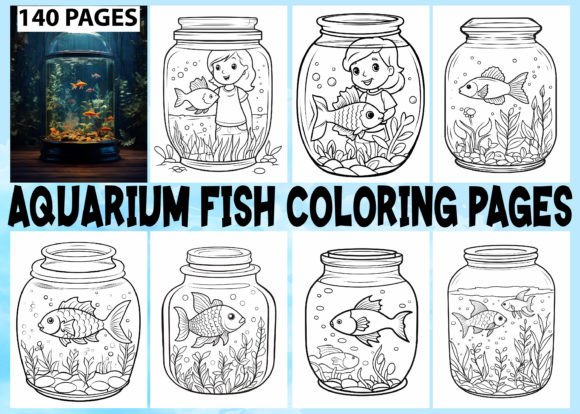
Imagine a rainy Saturday afternoon—your niece is restless, your classroom has 20 minutes before lunch, or your child’s therapist suggests a calming sensory activity. You open your laptop, unzip a folder labeled 140 Aquarium Fish Coloring Pages for Kids Volume 1, and print three pages: one with a smiling clownfish, another with a swirling seahorse, and a third showing a coral reef teeming with silhouetted angelfish. In under 90 seconds, you’ve handed over something that’s not just fun—but quietly purposeful.
More Than Just Lines on Paper
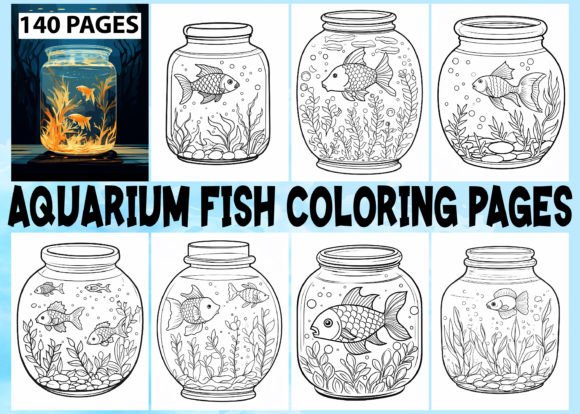
These aren’t generic fish outlines copied from clipart libraries. Each of the 140 Aquarium Fish Coloring Pages for Kids is hand-crafted with age-appropriate detail: bold outlines for small hands, balanced negative space to avoid overwhelm, and natural postures that spark curiosity—not confusion. A parrotfish isn’t just a shape; it’s a gently curved body with layered fins and subtle scale hints. A jellyfish floats with delicate tentacles spaced far enough apart for crayon control but close enough to invite focus. That intentional design makes all the difference when you’re working with a 5-year-old who’s still mastering grip—or a 9-year-old who’s ready to explore shading techniques.
Where These Coloring Pages Actually Show Up in Real Life
In classrooms: A second-grade teacher uses five pages as part of a marine biology mini-unit—students color while listening to short facts about habitats, then glue their finished fish onto a shared “ocean wall.” No prep time. No licensing worries. Just instant visual reinforcement.
In therapy settings: Occupational therapists print select pages (like the octopus with symmetrical arms or the slow-moving sea turtle) to support bilateral coordination and sustained attention. The predictable rhythm of coloring inside lines becomes grounding—not busywork.
At home during transitions: Parents use them as low-stimulus tools during big shifts—before doctor visits, after school pick-up, or during sibling downtime while one child naps. One mom told us she keeps a printed stack in her diaper bag “like emergency calm-down currency.”
In summer camps and after-school programs: Staff scan the PDF into tablets for digital coloring apps—or print batches for group stations. Because the files include both PNG and EPS formats, they scale cleanly for posters, T-shirt transfers, or laminated tracing cards without pixelation.
Why Format Variety Matters More Than You Think
You’ll get the full set in four formats—JPG, PNG, PDF, and EPS—all at true 300 DPI and sized for A4 or US Letter (8.5×11″). That’s not just technical detail—it’s flexibility in action.
- PNG files have transparent backgrounds, so you can drop a pufferfish onto a custom underwater scene in Canva—or layer it over a photo background for a unique bulletin board display.
- EPS files are vector-based, meaning you can stretch a single angelfish design across an entire 24×36″ poster without losing crispness—ideal for library storytime backdrops or classroom door decorations.
- PDFs open reliably on any device and retain bleed-safe margins, so when you’re assembling your own KDP interior, page alignment stays consistent—even if you rearrange the order or add your own title pages.
- JPGs load fast and work smoothly in most school printing systems, which often choke on complex vector files.
What to Consider Before You Start Using (or Publishing) Them
First—yes, these are black-and-white, high-contrast line art. That means they’re optimized for coloring, not for photo-realism or advanced illustration study. If you’re looking for anatomy references for art students aged 14+, this isn’t the resource. But if your goal is joyful engagement, fine-motor practice, or thematic learning for ages 3–10? It hits the mark.
Second—while all 140 pages are original and commercially licensed for resale (including KDP), they’re designed to be *starting points*, not final products. You’ll want to add your own voice: a friendly intro page, simple habitat facts beside each fish, or even blank journaling lines at the bottom (“What sound does a lionfish make?”). The zip file gives you raw material—not a finished book.
Third—the variety is thoughtful, not random. You’ll find familiar favorites (clownfish, betta, guppy), deep-sea oddities (blobfish silhouette, viperfish outline), and regional species (lionfish, mandarin dragonet) to gently broaden awareness beyond pet-store basics. But there are no copyrighted characters, no cartoon faces, and no branding—keeping the focus on real-world marine life.
Who Gets the Most Out of This Collection—and How
Self-publishing creators appreciate how cleanly these integrate into KDP interiors. You don’t need Illustrator skills to build a cohesive book—you can drag-and-drop into Word or Affinity Publisher, adjust spacing, add your cover, and hit “publish.” Many users pair Volume 1 with custom-written facts or simple rhyming text to create themed activity books (“Ocean ABC,” “Count the Coral Fish,” “My First Marine Journal”).
Educators building sub-plans love having 140 options on hand. When a substitute teacher needs a 45-minute fill-in activity, they can grab six pages representing different zones of the ocean (intertidal, pelagic, benthic) and turn coloring into a quiet classification exercise.
Therapists and special educators use specific pages intentionally: fish with repetitive patterns (striped zebra danio) for visual tracking, wide-open shapes (manta ray) for large-motor scribbling warm-ups, or clustered scenes (reef fish group) to encourage narrative storytelling (“Which fish is hiding? Who’s the biggest?”).
Parents seeking screen-free moments value the simplicity: no login, no ads, no battery life concerns. Just paper, color tools, and something that feels like play—but quietly builds observation, patience, and early science vocabulary.
Small Details That Add Up
The pages are sized for standard printers—but because they’re 300 DPI and built on clean vector foundations, they hold up beautifully even when slightly enlarged for younger kids or reduced for travel-sized booklets. The black-and-white contrast is rich and printer-friendly (no gray washouts or fuzzy edges), and the line weight stays consistent across all 140 designs—so a child doesn’t suddenly face a page with ultra-thin lines that vanish under heavy crayon pressure.
And yes—there are 30 bonus PNG cover options included, all at 300 DPI and fully resizable. They’re minimalist, ocean-toned, and free of distracting fonts or clutter, so you can overlay your own title in whatever style suits your audience: playful, educational, therapeutic, or whimsical.
This isn’t about filling time. It’s about offering a doorway—into curiosity, calm, creativity, or connection—with something as simple as a pencil and an aquarium fish coloring page.