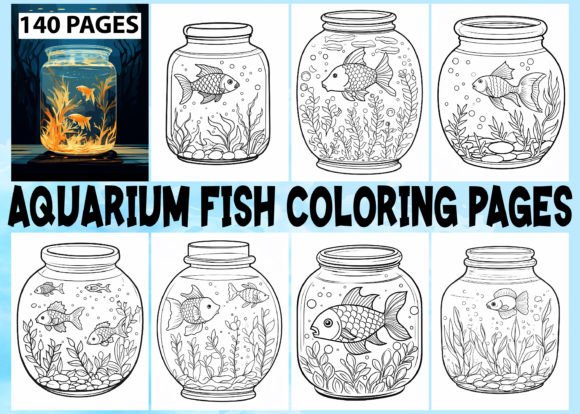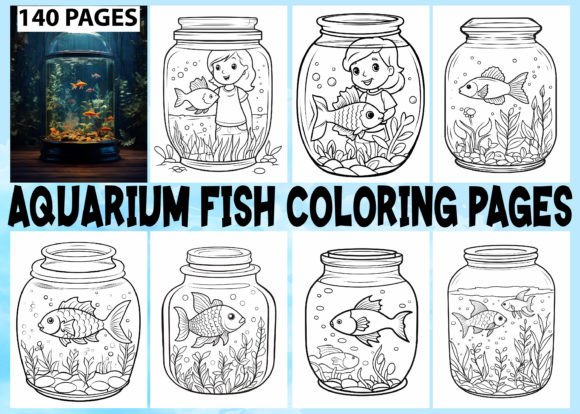
Why 140 Aquarium Fish Coloring Pages for Kids Is a Smart Choice for Your KDP Interior
Creating a high-content coloring book for Amazon Kindle Direct Publishing isn’t just about stacking images—it’s about delivering real value, consistency, and usability in every page. That’s exactly what the 140 Aquarium Fish Coloring Pages for Kid interior delivers: a thoughtfully curated, production-ready collection designed from the ground up for creators who prioritize quality, flexibility, and market readiness.
What You Actually Get—No Guesswork, No Gaps
This isn’t a generic bundle of clipart or low-res downloads. You receive a tightly organized .zip file containing four distinct, high-fidelity file types, all at 300 DPI and sized for standard print formats (A4 and 8.5×11″). Each format serves a specific purpose in your KDP workflow:
- EPS files — Scalable vector graphics ideal for precise editing in Adobe Illustrator or Affinity Designer. Resize without pixelation, adjust line weights, or isolate elements for custom layouts.
- PDF files — Print-perfect, single-page black-and-white layouts ready to drop into your KDP interior PDF. No extra conversion needed—just import and compile.
- JPG files — High-resolution raster images optimized for fast previewing, batch uploads, or use in Canva-based workflows.
- PNG files — Transparent-background versions useful if you plan to layer fish outlines over water-themed backgrounds or add subtle textures later.
Every one of the 140 Aquarium Fish Coloring Pages for Kid is hand-crafted with clean, confident linework—thick enough for young hands to color comfortably, yet detailed enough to hold visual interest for older kids and even adults exploring mindful coloring.
Designed for Real-World KDP Success
This interior has been stress-tested on the Kindle Direct Publishing platform—not just once, but across multiple live listings. That means no hidden surprises: margins align correctly, bleed settings are respected, and grayscale rendering stays crisp on both screen and print. The pages avoid common KDP pitfalls like thin lines that vanish during compression, overlapping elements that create unintended shadows, or overly dense shading that confuses young colorists.
Volume 2 expands on this foundation—not as a repeat, but as a deliberate evolution. Think of it as complementary biodiversity: where Volume 1 features classic angelfish, clownfish, and seahorses, Volume 2 introduces less-common species like mandarinfish, leafy sea dragons, and deep-sea lanternfish—all drawn with the same clarity and age-appropriate simplicity.
How These Pages Fit Into Modern Coloring Book Creation
Today’s successful KDP coloring books don’t rely on quantity alone. Buyers scan thumbnails, read interior previews, and expect cohesion—theme, tone, and technical polish. A disjointed mix of random fish silhouettes won’t cut it. But a unified set like the 140 Aquarium Fish Coloring Pages for Kid offers instant thematic consistency. It tells a story before the first page is turned: “This is an underwater world built for discovery.”
That cohesion translates directly into better customer reviews and lower return rates. Parents report that kids stay engaged longer when illustrations feel intentional—not just “fish-shaped,” but expressive, varied in pose and scale, and subtly educational (e.g., showing symbiotic relationships like cleaner shrimp on a grouper, or coral polyps surrounding a parrotfish).
Flexibility Without Compromise
You’re not locked into a rigid layout. Because each page is delivered individually—as separate EPS, JPG, PNG, and PDF files—you can reorder, group, or remix them however your vision demands. Want to open with wide-eyed tropical species and ease into more intricate deep-sea creatures? Done. Prefer to alternate between full-page scenes and bordered single-species studies? Easy. Need to insert activity pages—“Find the octopus,” “Count the bubbles,” or “Match the fish to its habitat”—between coloring spreads? The modular design supports that seamlessly.
The included cover assets (25 PNGs at 300 DPI) give you room to experiment too. Mix and match fish outlines with bubble motifs, coral borders, or gradient overlays—all while maintaining professional resolution. And yes—you can resize them freely. Unlike stretched JPEGs that blur at larger dimensions, these vector-friendly assets retain sharpness whether used on a 6×9 paperback cover or scaled up for a premium 8.5×11 hardcover edition.
Why Resolution Matters More Than You Think
300 DPI isn’t just a buzzword—it’s the baseline for crisp, publishable print. At lower resolutions, fine details (like gill slits, fin rays, or tiny scales) dissolve into gray mush. On KDP’s automated print system, anything under 250 DPI risks automatic rejection or soft warnings that delay your launch. With every file in this pack hitting exactly 300 DPI—and confirmed across all four formats—you eliminate guesswork and reduce time-to-market.
Bonus insight: Even if you’re planning a digital-only version (e.g., a PDF download via Gumroad or your own site), high-DPI originals future-proof your work. You can always downsample for web use—but you can’t meaningfully upscale a blurry image without introducing artifacts.
Practical Use Cases Beyond the Obvious
Yes, this is ideal for a standalone aquarium-themed coloring book. But savvy creators go further:
- Combine with learning content: Pair select pages with short facts (“Did you know? Clownfish live among sea anemones—they’re immune to the sting!”) to build an early-science activity book.
- Create themed bundles: Merge 30–40 pages from Volume 1 and Volume 2 with ocean-themed mazes or word searches to produce a “Summer Ocean Fun Pack” for teachers or homeschoolers.
- Support sensory development: Print select pages on textured paper or laminate them for dry-erase use—ideal for occupational therapy settings or special education classrooms.
- Repurpose for merch: Pull clean outlines from EPS files to create iron-on transfers, stickers, or printable wall art—extending your IP beyond the book itself.
What to Consider Before You Launch
While this interior is KDP-optimized, success still depends on smart execution. First, verify your trim size matches the files—8.5×11″ and A4 require different margin setups. Second, double-check your KDP previewer: upload a 10-page test PDF to confirm line clarity and contrast before submitting the full interior. Third, consider adding a brief intro page—even one sentence (“Dive into 140 friendly fish friends waiting for your colors!”)—to boost perceived value and guide younger users.
Also remember: Amazon’s algorithm favors books with strong interior previews. Since every one of the 140 Aquarium Fish Coloring Pages for Kid is visually consistent and high-contrast, your Look Inside sample will load quickly and display cleanly—giving browsers confidence before they click “Add to Cart.”
Final Thought: It’s Not Just Pages—It’s a Foundation
When you invest in a resource like this, you’re not buying static images. You’re acquiring a production-grade foundation—one that saves hours of sourcing, editing, and troubleshooting. You’re gaining creative breathing room to focus on what matters most: branding, audience targeting, and thoughtful presentation. Whether you're launching your first KDP coloring book or scaling a portfolio of niche titles, the 140 Aquarium Fish Coloring Pages for Kid interior gives you reliable, beautiful, and commercially proven material—ready to turn into something memorable.