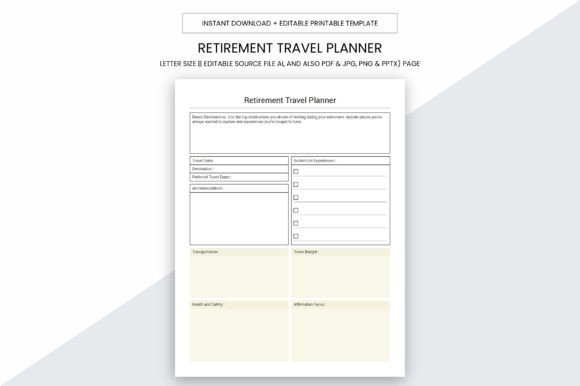
Retirement Travel Planner: A Practical Tool for Organized, Purposeful Travel Planning
A Retirement Travel Planner is not just another notebook—it’s a purpose-built system designed to support long-term travel goals during retirement or semi-retirement. Unlike generic journals or digital apps that prioritize aesthetics over utility, this planner integrates structure, flexibility, and print-ready functionality into a single resource. At its core, it serves as both a planning companion and a living archive: helping users map destinations, track budgets, record health considerations, log accommodations, and preserve memories—all within a consistent, accessible format.
What Sets This Retirement Travel Planner Apart
The most distinctive feature is its intentional design for real-world use—not theoretical convenience. Measuring 8.5 x 11 inches with no bleed, it aligns precisely with standard US letter-size printing and binding requirements. That means no trimming surprises, no lost margins, and seamless compatibility with local print shops or self-publishing platforms like Kindle Direct Publishing (KDP). Its 109-page interior PDF is pre-formatted for KDP upload, eliminating common formatting hurdles such as incorrect margins, inconsistent headers, or unsupported fonts.
Beyond physical specifications, the file package includes editable source files in Adobe Illustrator (.ai), plus multiple output formats: PDF (print-optimized at 300 ppi), JPG, PNG, and PPTX. This versatility supports different workflows—whether you’re customizing layouts for a small business, adapting pages for client workshops, or preparing presentation slides for travel-planning seminars. The high-resolution output ensures crisp text and clean lines, critical when printing checklists, maps, or itinerary grids.
How It Compares With Other Planning Approaches
Many travelers rely on digital tools—apps like TripIt, Notion templates, or Google Sheets—to manage trips. These offer searchability, cloud sync, and automation—but they also require consistent device access, internet connectivity, and ongoing subscription management. A printed Retirement Travel Planner provides tactile reliability: no battery life concerns, no app updates disrupting layout, and no risk of data loss from platform changes or account deactivation.
Compared to standard travel journals, this planner avoids open-ended blank pages. Instead, it uses guided prompts and structured sections—such as “Pre-Departure Health Checklist,” “Visa & Documentation Tracker,” or “Monthly Budget Summary”—to reduce decision fatigue. That structure matters especially for retirees managing variable income streams, chronic conditions, or mobility considerations where clarity and consistency directly impact safety and confidence.
Some planners emphasize minimalism or aesthetic appeal—thin paper, decorative motifs, or limited page counts. This Retirement Travel Planner prioritizes durability and utility: thick, printer-friendly stock (when printed locally), logical section sequencing, and space-efficient yet legible typography. It doesn’t assume users want to sketch or journal extensively; rather, it assumes they want to record, reference, and act.
Use Cases Where It Delivers Clear Value
This planner fits well in three overlapping contexts: personal organization, commercial service delivery, and KDP publishing.
- Personal use: Ideal for individuals beginning retirement travel who value having one place to consolidate flight confirmations, insurance details, medication schedules, and contact lists. Its size allows portability without bulk, and the editable files let users add custom pages—say, a “Local Emergency Numbers” sheet for each country visited.
- Commercial use: Small travel advisors, senior-focused tour operators, or retirement coaches can brand and repackage the source files—adding their logo, modifying cover text, or inserting proprietary worksheets—then offer printed versions to clients. Because the files are editable and print-ready, customization doesn’t require graphic design expertise or third-party vendors.
- KDP publishing: For creators building a catalog of niche planning tools, this interior offers a turnkey solution. The 109-page count meets KDP’s minimum for paperback interiors, and the absence of bleed simplifies cover matching. Combined with an original cover design, it becomes a publishable product in under an hour—no typesetting, no export troubleshooting, no trial-and-error testing.
Tradeoffs and Realistic Considerations
No tool suits every need—and understanding limitations helps avoid mismatched expectations. Because this Retirement Travel Planner is print-based and static once printed, it lacks dynamic features like automatic currency conversion, live weather integration, or GPS-linked location logging. If your workflow depends heavily on syncing across devices or pulling live data, a hybrid approach may be more effective: using the planner for high-level planning and reflection while supplementing with select apps for real-time functions.
Also, while the editable AI file enables customization, it does require basic familiarity with Adobe Illustrator—or willingness to learn or outsource minor edits. Users comfortable only with Word or Canva may find the learning curve steeper than expected, though the included PDF remains fully functional without any editing.
Another consideration is scalability. For someone planning dozens of international trips per year, even 109 pages may fill quickly—especially if they use generous handwriting or include printed attachments. In those cases, purchasing multiple copies—or combining this planner with a simple binder system for archival—may extend usability without compromising structure.
When to Choose This Over Alternatives
This Retirement Travel Planner makes sense when your priorities include:
- Reliability over novelty: You prefer knowing exactly how a page will look and function before printing—not relying on app updates or platform stability.
- Local print readiness: You work with a nearby print shop and need files that produce professional results without technical back-and-forth.
- Reusability across roles: You’re evaluating tools not just for personal use but also as a foundation for client-facing materials or passive income products.
- Clarity in complexity: You’re navigating layered logistics—health documentation, multi-currency budgeting, visa timelines—and benefit from pre-defined categories rather than starting from blank.
It’s less ideal if you primarily plan short domestic weekend trips, rely exclusively on voice notes or photo-based memory capture, or need built-in reminders or calendar sync. In those cases, lightweight digital alternatives may better match daily habits.
Making an Informed Choice
Evaluating a Retirement Travel Planner isn’t about finding the “best” option—it’s about identifying the right fit for your current context, constraints, and goals. Ask yourself: Do I need something I can hold, annotate, and reference without screen glare? Am I building resources for others—not just using them myself? Will this support decisions I’m making now, not just ideas I’m collecting?
The inclusion of editable source files, KDP-ready formatting, and high-resolution print specs reflects attention to practical execution—not just conceptual appeal. That focus translates into time saved, fewer formatting errors, and smoother transitions from idea to finished product—whether you’re packing for Costa Rica, designing a workshop handout, or uploading your first KDP title.
Ultimately, a Retirement Travel Planner works best when treated as infrastructure: quiet, dependable, and designed to recede into the background so your travel planning stays front and center.