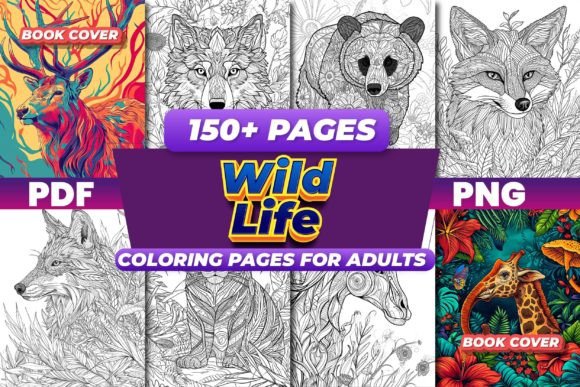
Wild Life Coloring Pages for Adults
Wild life coloring pages for adults offer more than just quiet time with colored pencils—they’re a thoughtful bridge between mindfulness, creative expression, and nature appreciation. Designed with intricate linework, balanced negative space, and biologically inspired details, these pages resonate deeply with adults seeking restorative focus—not childish simplicity. Whether you're unwinding after work, teaching ecology concepts in a classroom, or developing a best-selling Amazon KDP coloring book, the right collection makes all the difference. But not every “wildlife” download delivers what it promises—and that’s where practical awareness matters most.
What Many Overlook Before Downloading
It’s easy to assume “150 wildlife images” means variety, clarity, and usability—yet many buyers discover too late that their digital download includes repetitive poses, low-resolution files unsuitable for printing, or line art so thin it vanishes on home printers. Others expect seamless integration into design workflows only to find PNGs without transparent backgrounds or PDFs missing bleed margins and crop marks. These aren’t minor hiccups—they directly impact print quality, professional presentation, and even customer satisfaction if you’re selling finished books.
For example, one creator assumed her “A4-sized” wildlife coloring pages would scale perfectly to US letter (8.5×11 inch) without distortion—only to realize half the animal’s head was cropped off in final proofs. Another downloaded a set labeled “300 DPI,” but opened the files to find they were saved at 72 DPI and pixelated when enlarged. Neither issue is obvious from thumbnails or marketing copy alone.
Why Image Format and Consistency Matter More Than Quantity
Having 150 PNGs sounds impressive—until you open them and find inconsistent line weights, mismatched styles (some sketchy, some ultra-detailed), or animals drawn from unnatural angles that disrupt flow across a coloring book spread. A cohesive collection should maintain visual rhythm: similar stroke thickness, consistent spacing between elements, and intentional composition that guides the eye—not confuses it.
Look beyond the count. Ask: Are all animals rendered with anatomical plausibility? Do butterflies have symmetrical wings? Do elephants show accurate ear folds and trunk texture? Subtle inaccuracies may go unnoticed by casual colorers—but educators, wildlife advocates, and serious hobbyists notice. And if you're building a brand around authenticity, those details shape credibility.
What to Verify Before You Buy—or Use—Wild Life Coloring Pages for Adults
- Test one file first: Download a free sample (if offered) and print it at actual size. Check for crisp lines, no gray halos, and proper margins—especially near edges where binding or trimming occurs.
- Confirm DPI *and* export method: 300 DPI only helps if the image was originally created at that resolution—not upscaled. Open a file in Photoshop or Preview and check its actual pixel dimensions (e.g., 2480×3508 px for A4 at 300 DPI).
- Review licensing terms clearly: Some AI-generated collections restrict commercial use or require attribution—even for KDP. Make sure your intended use (personal, resale, merch, classroom handouts) is explicitly permitted.
- Check cover compatibility: If you plan to self-publish, verify whether cover PNGs include layered files or high-res flat versions. Resizing a small cover image often degrades quality faster than interior pages.
Avoiding the “Too Cute, Not Accurate” Trap
Some wildlife coloring pages lean heavily into cartoonish charm—oversized eyes, smiling foxes, anthropomorphized poses. That’s fine for children’s books—but adults often seek realism, reverence, or educational nuance. A lion drawn mid-roar with visible teeth and tension in the jaw reads as powerful; the same lion winking with heart-shaped pupils reads as incongruous. This isn’t about banning creativity—it’s about matching style to audience intent.
If your goal is stress relief, moderate complexity with breathing room between lines works best. For educators, clear labeling options (like blank spaces for species names) add value. For KDP creators, consider how each page supports a theme—“Savanna Mammals,” “Rainforest Insects,” or “Ocean Giants”—rather than random assortment. Thematic grouping improves perceived quality and encourages repeat purchases.
How AI Generation Changes the Game—Responsibly
AI tools now produce stunning, detailed wildlife illustrations—but not all outputs are coloring-ready. Some lack closed shapes (making fill tools unreliable), others overuse gradients or textures that don’t translate to black-and-white line art. The best Wild Life Coloring Pages for Adults use AI as a collaborator: generating base forms, then refining outlines manually for consistency, clarity, and print integrity.
You’ll know it’s well-executed when line weight stays legible at 50% zoom, when overlapping elements (like vines over a tiger’s back) remain distinct, and when fine details—feather barbs, scale patterns, leaf veins—enhance rather than overwhelm. That balance separates functional art from decorative noise.
Final Thought: It’s Not Just About Coloring—It’s About Intention
Choosing Wild Life Coloring Pages for Adults isn’t just about filling pages—it’s about honoring attention, supporting learning, and creating something that feels meaningful to hold and use. Whether you’re printing for yourself, designing for clients, or launching a product line, prioritize clarity over quantity, accuracy over whimsy, and usability over aesthetics alone. When done right, these pages become quiet invitations—to observe closely, breathe deeply, and reconnect with the wild world, one deliberate stroke at a time.